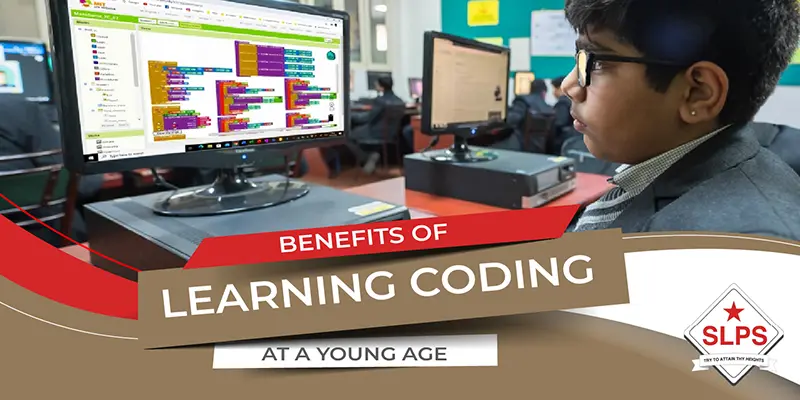
Children grow up surrounded by phones, computers, games and websites. Most know how to use them from an early age. Coding takes this one step further. It shows children how these things work and how they can make something of their own.
The benefits of learning coding at a young age are not limited to computer skills. Coding asks children to think, plan, check their work and fix mistakes. A child may start by moving a character across a screen and later create a small game, webpage or program.
Parents who search what is coding for kids often think it may be too difficult for young children. It does not have to be. Kids can start with simple blocks, pictures and commands before moving to languages such as Python.
Benefits of Learning Coding at a Young Age and Why Children Should Start Early
Parents often search for coding sikhne ke fayde when deciding whether coding is useful for their child. One of the biggest benefits of coding is that children learn by doing. They write an instruction, see what happens and make changes when something does not work.
Here are some ways coding can help children during their school years.
1. Children Learn How to Solve Problems
Coding is full of small problems. A character may not move in the right direction. A button may not work. A game may stop halfway. Children have to find out what went wrong.
This teaches them to look at a problem in smaller parts. They try one solution, check it and try another if needed. Coding for beginners works well when children get small tasks that they can understand and finish on their own.
2. Coding Gives Children a Chance to Make Things
Children enjoy activities where they can see the result of their work. Coding gives them plenty of such opportunities.
They can make a quiz, draw with code, build a basic webpage or create a small game. They are not simply watching something on a screen; they are deciding what should happen on it.
This type of learning fits well with the C.R.E.A.T.E Curriculum, where children get opportunities to learn through different activities and experiences.
3. It Helps Children Think in the Right Order
Code has to follow an order. If the steps are mixed up, the program may not work. Children soon learn that the first, second and third steps matter.
This habit is useful outside a computer class too. It can help while working through a maths problem, writing an answer, following science instructions or planning a school project.
The school’s
Progressive Learning approach can also give students opportunities to use what they learn instead of depending only on memorising answers.
4. Children Understand Computers Better
There is a big difference between playing a game and knowing how a game works.
Coding helps children understand that apps, websites and games are built using instructions. They begin to see computers as tools they can control rather than screens made only for watching videos or playing games.
Through the ICT 360 Computer Curriculum, students can get more familiar with computers while studying at school.
5. Making Mistakes Becomes Part of Learning
A wrong line or command can stop a program from working. That sounds frustrating, but it teaches an important lesson.
Children learn to check their own work. They look for the mistake and correct it. When the program finally runs, they can see exactly what their effort achieved.
The same habit can be useful during
Progressive Assessments, classwork and regular studies.
6. Coding Can Be a Group Activity
Coding does not always mean sitting alone in front of a computer. Children can work together on games, presentations and small projects.
One child may suggest an idea while another writes the commands. Someone else can test the project and point out what needs fixing.
School activities such as Activity Clubs and In House Competitions & Awards can also give children different ways to work with classmates and show what they have learned.
7. It Can Help Children Find What They Enjoy
Some children enjoy drawing. Others like maths, games, puzzles or building things. Coding can connect with many of these interests.
A child who enjoys it may later explore web design, game development, Python, robotics or app development. As children get older, they can look at suitable coding courses, online coding courses and best programming courses based on what they want to learn.
The aim at a young age should not be to choose a career. It should be to give children enough exposure to find out what they like.
How to Learn Coding at Home Without Making It Feel Like Homework
Parents searching how to learn coding at home can begin with very small projects. A 15- or 20-minute activity can be more useful for a beginner than a long lesson.
Start with visual coding where children drag and arrange blocks. Ask them to make a character walk, speak or change direction. Once they understand basic commands, they can try games, animations and simple programs.
If your child asks how to learn coding, choose activities that match their age rather than starting with difficult programming lessons.
Coding should also leave time for
Sports, reading, schoolwork and other interests. A child’s Academic Session & timings can help parents plan a routine without adding too much screen time.
Coding as Part of Everyday School Learning
Computer knowledge is one part of a child’s education, not the whole of it. Children also need language skills, maths, physical activity, art, teamwork and time to explore their interests.
That is why coding can sit naturally alongside
Pre-Foundation, Approach towards Academics, classroom activities and practical learning.
Programs such as Parent-Teacher-Mentor Programs can also help parents understand how their child is doing at school. Our Achievements and Awards & Scholarships can give families a look at different areas in which students take part and perform well.
At SilverLine Prestige School, Learning coding early does not mean every child has to become a programmer. Its value lies in giving children another way to think, make, test and learn. Those habits can stay useful whether a child later chooses computers, science, design, business or something completely different.
FAQs
What is coding for kids?
It means teaching children simple computer instructions through games, blocks, animations and small projects.
What are the benefits of coding for children?
Coding can help with problem-solving, logical thinking, creativity and computer knowledge.
Is coding for beginners difficult?
No. Beginners can start with simple visual coding before learning written programming languages.
How can children learn coding at home?
They can begin with short coding activities, simple games, animations and beginner lessons.
Which coding courses are suitable for children?
Choose coding courses according to the child’s age, current skills and interest.