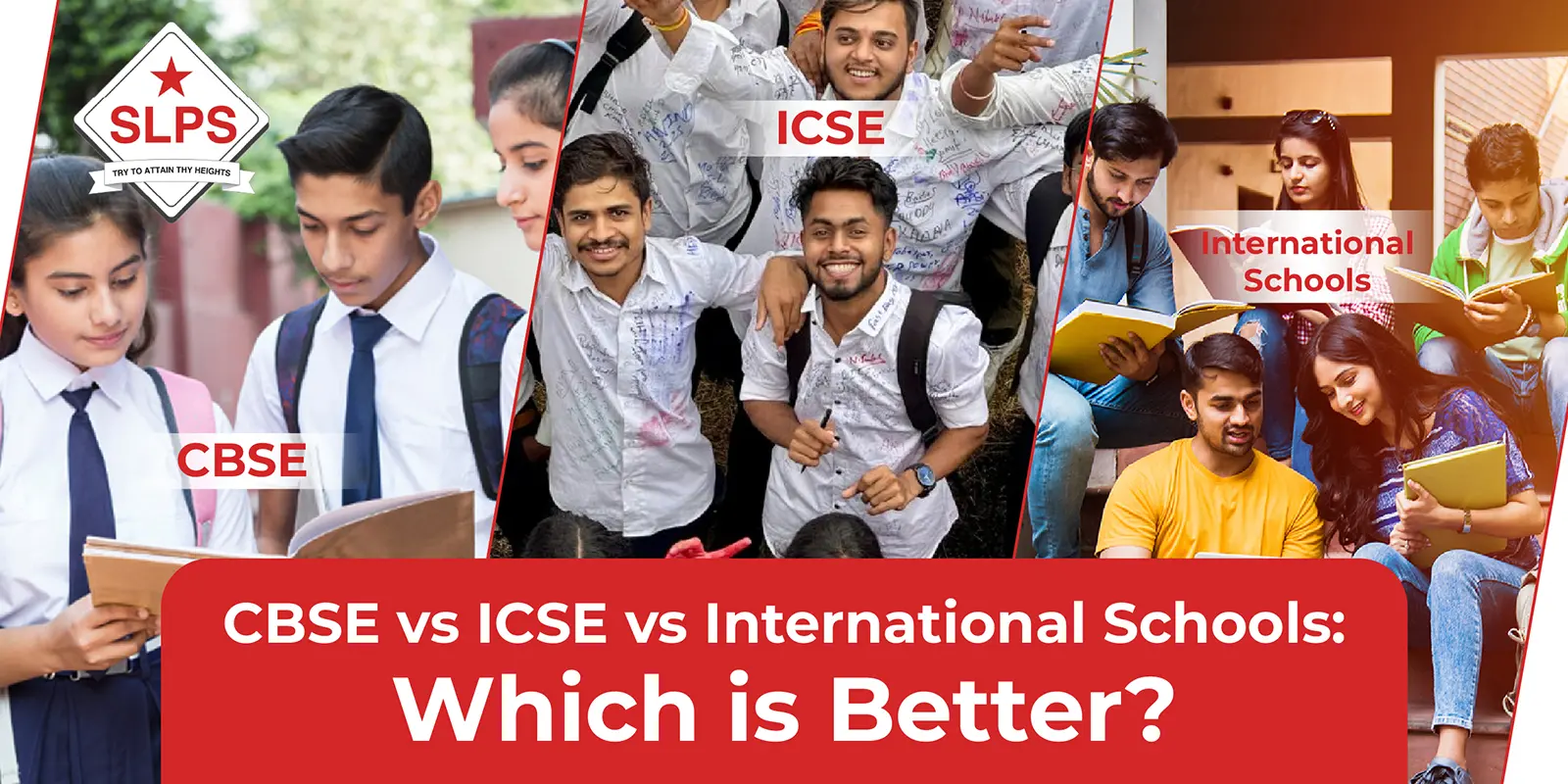
Choosing a school board is rarely simple. One parent may recommend CBSE, another may say ICSE builds better language skills, while someone else may strongly support IB or Cambridge. This leaves many families asking, “CBSE vs ICSE vs International Schools: Which Is Better?” The truth is that no board suits every child. The better choice depends on your child’s interests, study habits, future plans, comfort with homework, and the kind of classroom environment in which they learn happily.
Start With the Child, Not the Board Name
Parents often begin by comparing syllabus size, exam patterns, or school fees. These things matter, but they should not come first.
Think about how your child studies. Some children like clear notes, regular tests, and a fixed routine. Some learn better when they can discuss ideas, make models, conduct experiments, or work on projects. A child who enjoys detailed reading may respond well to one board, while another who prefers direct lessons may feel more comfortable in a different one.
The board should support the child’s way of learning instead of making school feel like a daily struggle.
What Is CBSE Like for Students?
CBSE is widely available across India. Its syllabus follows a clear order, and most schools use NCERT books. This makes lessons easier to track, especially for families who move from one city to another.
The board gives good attention to Mathematics and Science. Students who plan to prepare for JEE, NEET, CUET, or other Indian entrance exams often choose CBSE because many exam topics connect closely with NCERT books.
CBSE can work well for a child who likes:
- A fixed and organised syllabus
- Regular written practice
- Straightforward study material
- Mathematics and Science
- Preparation for Indian entrance exams
The syllabus is usually less detailed than ICSE. That does not mean students learn less. Much depends on the school and teachers. A good CBSE school will explain ideas through activities, lab work, examples, and classroom discussion rather than asking children to memorise answers.
What Makes ICSE Different?
ICSE gives students a wider and more detailed syllabus. English receives strong attention, but the board also covers science, history, geography, computer studies, arts, and project work in depth.
Students usually write longer answers and spend more time on assignments, practical work, and internal assessments. This can improve writing, presentation, and explanation skills.
Parents frequently search, “Is ICSE international board?” ICSE is not an international board. It is an Indian curriculum managed by CISCE. Still, its English teaching and broad subject coverage can help students who later plan to apply to universities outside India.
ICSE may suit children who enjoy:
- Reading stories, essays, and literature
- Writing detailed answers
- Learning languages
- Working on projects
- Studying different subjects in depth
The workload can feel heavy, especially in higher classes. Before choosing it, parents should consider whether their child enjoys detailed study or becomes anxious when the syllabus grows.
How Are International Schools Different?
International schools usually follow IB or Cambridge programmes. Their classroom style can feel quite different from regular board schools.
Students do not only read chapters and prepare written answers. They may take part in debates, group work, presentations, research tasks, experiments, and community projects. Teachers often ask students why they think something is true and how they can apply it outside the classroom.
This approach can help children become confident speakers, independent learners, and better problem-solvers.
International boards may suit families who expect to move abroad or children who may apply to overseas universities later. The qualifications are accepted in many countries, which makes changing education systems easier.
The cost is often higher. Students who want to sit for Indian medical or engineering entrance exams may also need separate preparation because the syllabus does not always match NCERT topics in the same way CBSE does.
Which Board Is Best: CBSE or ICSE?
Parents often ask, “Which board is best, CBSE or ICSE?” A better question would be: which board is easier for my child to understand and manage?
CBSE may be a suitable option when a student wants to prepare for Indian entrance exams, prefers a compact syllabus, or may need to change schools because of family transfers.
ICSE may be a better fit when a student enjoys reading, writing, practical assignments, and detailed lessons. It can also help children build a strong command of English.
When comparing ICSE or CBSE which is better, do not decide only on marks or board results. A skilled teacher in a caring school can make a difficult topic easy. Poor teaching can make even a simple syllabus frustrating.
Difference Between IB and ICSE
The main difference between IB and ICSE is the way students approach a topic.
In ICSE, students usually study a chapter, understand the explanation, complete assignments, and prepare for written exams. Projects and practical work are also part of the course.
In IB, a student may start with a question, research it, discuss it with classmates, gather information, and present findings. The teacher guides the student, but the child takes more responsibility for the learning process.
For example, while studying water pollution, an ICSE student may learn causes, effects, and prevention through textbooks and project work. An IB student may study a nearby water source, collect data, speak with people, and prepare a report.
Both methods can build strong knowledge. The right one depends on whether the child prefers fixed guidance or open-ended learning.
Look Closely at the School Too
The school matters as much as the board. Two schools offering the same curriculum may give children very different experiences.
Before
admission, parents should ask about teacher experience, class size, homework, sports, arts, counselling, student safety, and support for children who need extra help.
While considering
SilverLine Prestige School, parents should look at how lessons are taught, how teachers communicate with families, and whether students get enough space to ask questions. Visiting the campus, meeting teachers, and speaking with current parents can give a clearer picture than reading a brochure.
The best choice is the one that keeps your child interested in learning without placing unnecessary pressure on them.
Frequently Asked Questions
1. Is ICSE an international board?
No. ICSE is an Indian board, although many universities abroad accept its qualifications.
2. Which board is best, CBSE or ICSE?
CBSE may suit entrance exam preparation, while ICSE may suit detailed learning and strong language development.
3. What is the difference between IB and ICSE?
IB gives more weight to research and presentations. ICSE follows a detailed syllabus with exams, projects, and practical work.
4. Are international schools better than CBSE?
Not for every child. The answer depends on future plans, budget, learning style, and school quality.
5. Can students move from ICSE to CBSE?
Yes. They may need time to adjust to changes in textbooks, answer writing, and syllabus depth